Mind Video
☷Table of contents▾
Mind Video
Freemium
Mind-Video: Unleashing Brain’s Visual Secrets
VISIT WEBSITE
Most popular alternative: PostPerfect
Introduction:
Are you ready to witness the incredible power of AI tools? Imagine being able to reconstruct vivid videos from brain activity alone. Introducing Mind-Video, an innovative solution that harnesses the potential of continuous functional magnetic resonance imaging (fMRI) data to recreate visual experiences.
Building upon the success of Mind-Vis, Mind-Video takes fMRI-image reconstruction to new heights. It tackles the challenge of recovering seamless visual journeys from non-invasive brain recordings. Through a two-module pipeline, this tool bridges the gap between image and video brain decoding, resulting in astonishingly accurate and dynamic videos.
With its flexible and adaptable pipeline, Mind-Video employs a progressive learning scheme that enables the fMRI encoder to assimilate nuanced semantic information. By leveraging large-scale unsupervised learning, multimodal contrastive learning, and augmented stable diffusion models, this tool surpasses previous state-of-the-art approaches. Its attention analysis reveals the dominance of the visual cortex in processing visual spatiotemporal information, unlocking the hierarchical nature of the encoder’s layers.
Powered by data from the Human Connectome Project and supported by a dedicated team of collaborators, Mind-Video is revolutionizing the field of brain decoding. Experience the future of video reconstruction and unlock the secrets hidden within the human mind.
Overview:
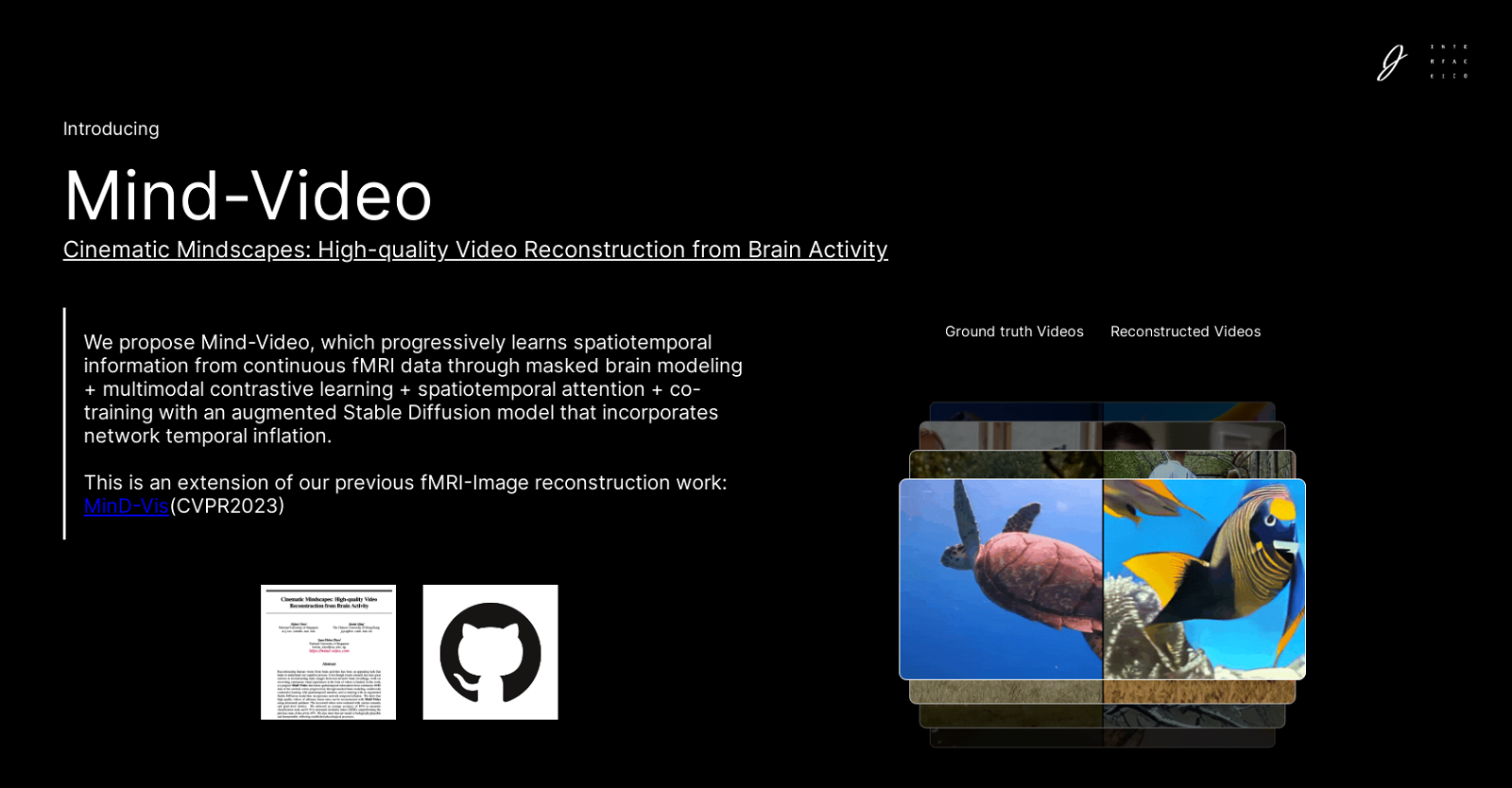
Mind-Video is an AI tool that reconstructs high-quality videos from brain activity captured through continuous functional magnetic resonance imaging (fMRI) data. It builds upon the previous fMRI-Image reconstruction work called Mind-Vis and addresses the challenge of recovering continuous visual experiences in the form of videos from non-invasive brain recordings.
The tool employs a two-module pipeline that bridges the gap between image and video brain decoding. The first module focuses on learning general visual fMRI features through large-scale unsupervised learning with masked brain modeling and spatiotemporal attention. It then distills semantic-related features using multimodal contrastive learning with an annotated dataset.
In the second module, the learned features are fine-tuned through co-training with an augmented stable diffusion model, specifically designed for video generation guided by fMRI data. The tool’s contribution lies in its flexible and adaptable pipeline, consisting of an fMRI encoder and an augmented stable diffusion model trained separately and finetuned together. It employs a progressive learning scheme that enables the encoder to learn brain features through multiple stages.
The resulting videos generated by Mind-Video demonstrate high semantic accuracy, including motions and scene dynamics, surpassing previous state-of-the-art approaches. Attention analysis of the transformers decoding fMRI data reveals the dominance of the visual cortex in processing visual spatiotemporal information and the hierarchical nature of the encoder’s layers in extracting structural and abstract visual features. The fMRI encoder also shows progressive improvement in assimilating more nuanced semantic information throughout its training stages.
Mind-Video utilizes data from the Human Connectome Project and acknowledges the contributions of collaborators and supporters in its development.
Benefits:
- Mind-Video is an AI tool that aims to reconstruct high-quality videos from brain activity captured through continuous functional magnetic resonance imaging (fMRI) data.
- The tool addresses the challenge of recovering continuous visual experiences in the form of videos from non-invasive brain recordings.
- Mind-Video employs a two-module pipeline that bridges the gap between image and video brain decoding.
- The tool’s contribution lies in its flexible and adaptable pipeline, which consists of an fMRI encoder and an augmented stable diffusion model trained separately and finetuned together.
- Mind-Video utilizes data from the Human Connectome Project and acknowledges the contributions of collaborators and supporters in the development of the tool.

Writer at TechLaugh, covering practical AI tools for creators and businesses.